
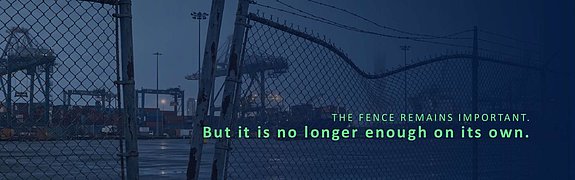
When the Fence Is No Longer Enough
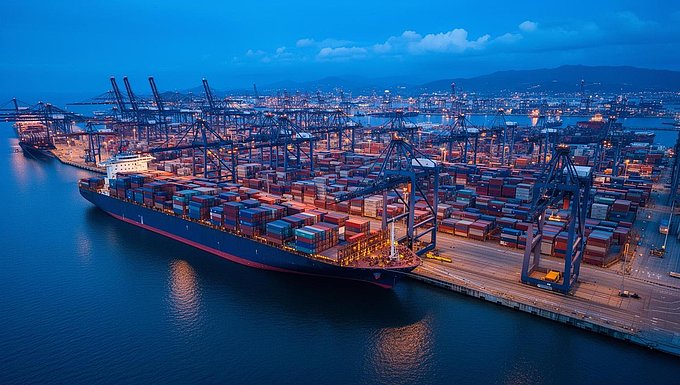
The new reality of port security
Why harbour security has to change fundamentally
On land, ports are well protected. Yet the incidents of recent months came from the air, across the water, from beneath the surface and through the radio spectrum. For port operators, this means one thing: security has to begin where the fence ends.
A submarine hit in its own harbour
On 15 December 2025, Ukraine’s Security Service (SBU) released footage of an explosion at the naval base in Novorossiysk on the Black Sea. According to Ukrainian sources, an underwater drone struck a Russian Kilo-class submarine at its berth – the first attack of its kind, the SBU said. Russia denies that any vessel was damaged.
How much damage was actually done cannot be judged from the outside. What the case shows, however, is clear. Russia had moved large parts of its Black Sea Fleet to Novorossiysk to keep them out of reach of Ukrainian strikes. The port was considered a safe haven. The attack came anyway – not over land, but under water.
For civilian ports in Europe, this is not a war scenario. It is an indication of which capabilities are available today – and of how little conventional perimeter security can do against them on its own.
Ports: critical, open, vulnerable
According to the Federal Statistical Office, German seaports handled 284.4 million tonnes of cargo in 2025, 3.8 per cent more than in the previous year. Hamburg alone accounted for 99.8 million tonnes. PLATH and Eraneos estimate that seaborne goods worth around two billion euros pass through German ports every working day. They carry energy imports, raw materials and industrial goods – and, in a crisis, the deployment of armed forces.
At the same time, a port is one of the most open facilities there is. On the landward side, it can be closed off with fences, gates and access control. On the seaward side, there is no such boundary. Water areas, quay walls, the harbour entrance and the fairway are open, and they have to be – otherwise the port cannot function. Then there is the airspace above the site and the seabed with its cables and pipelines.
Anyone who wants to protect a port therefore has to think in distances, not in boundaries. What matters is the stand-off distance: the distance from which a threat can take effect without ever entering the site. On the water side, that quickly amounts to several kilometres of open space – with no fence, no gate and no control.
Request the white paper!
“Germany’s ports are not defenceless. However, they are not sufficiently resilient to cope with the hybrid threat landscape of the coming years.” This is the key finding of the joint white paper by PLATH and Eraneos. It highlights what is at stake in the event of an emergency and how existing systems can be integrated to provide a shared situational picture.
Request the white paper now!
From above: drones over critical infrastructure
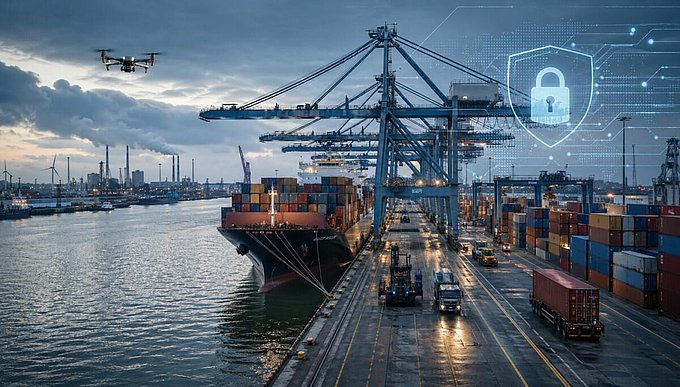
At the end of September 2025, according to reports by Der Spiegel, drones were sighted over the Thyssenkrupp Marine Systems submarine shipyard in Kiel, over port facilities on the Kiel Fjord and over the refinery in Heide, some of them flying in formation. A few days earlier, drones had shut down Copenhagen Airport. By mid-December 2025, Germany’s Federal Criminal Police Office (BKA) had registered more than 1,000 suspicious drone flights in the country. Most affected were military sites and airports, but defence companies and port facilities were also targeted.
Not every overflight is an attack. Drones can be used for reconnaissance, to unsettle, or to prepare. For port operators, that is exactly the problem: a fence does not stop a drone, and a camera often only picks it up once it is already above the site.
In the spectrum: when the operational picture itself is disrupted
A third threat is harder to grasp because it is not physical. Interference with satellite navigation (GNSS) has been increasing in the Baltic Sea region for years. In January 2026, the coastal states of the Baltic and North Seas, together with Iceland, warned in an open letter that the interference emanating from Russia endangers the safety of international shipping: “All ships are at risk.” The letter explicitly also names the spoofing and manipulation of AIS data. Interference is rising over Germany, too: in aviation, the number of reported GPS disruptions grew from 25 in 2023 to 447 in 2025.
For harbour security, this matters in two ways. First, navigation in narrow fairways becomes riskier. Second, the operational picture becomes less reliable: if position data can be faked, the screen no longer necessarily shows what is really happening on the water.
On top of this come cyberattacks on the IT and OT systems of terminals and port authorities. They, too, bypass every fence. The Japanese port of Nagoya showed in 2023 how quickly this can happen: after a ransomware attack, cargo handling in the country’s largest port came to a standstill for around three days.
What these threats have in common
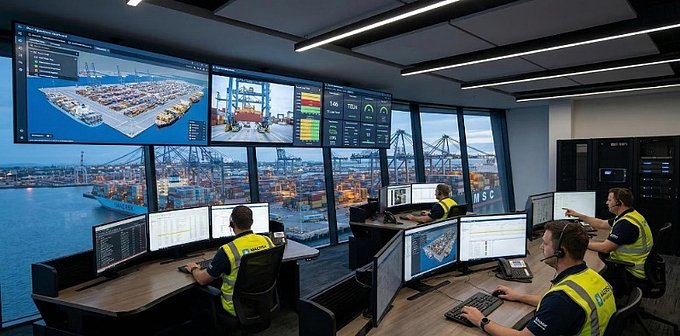
Drones, underwater vehicles, the shadow fleet, GNSS interference: at first glance, these threats have little to do with one another. But they share one decisive feature. They do not begin at the fence – and usually not with the actual attack either.
Hardly any operation against a well-protected target takes place without prior reconnaissance. Someone has to scout the situation, observe berths, plan routes and coordinate forces. Most unmanned systems depend on radio links for this – for control, navigation or video transmission. And anyone acting on the ground has to coordinate with others.
“Anyone preparing an attack has to carry out reconnaissance. And reconnaissance leaves traces. The question is whether you detect them before someone is standing at the fence.”
Dirk Dullinger, Senior Sales Manager, PLATH
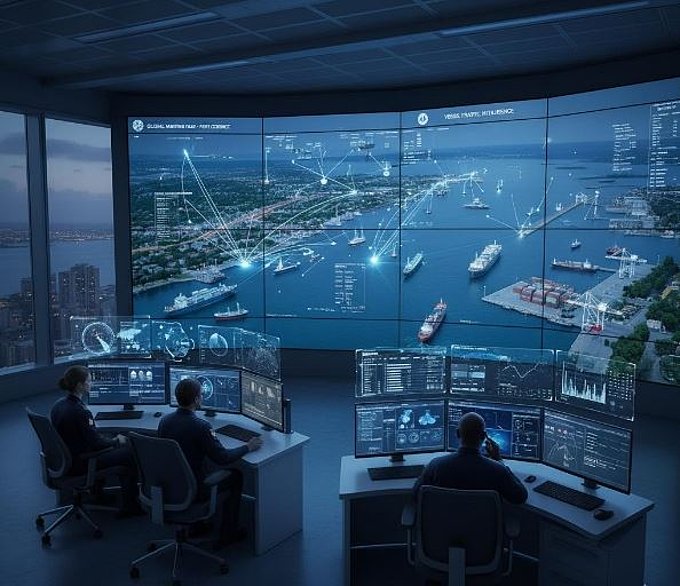
This is where the real opportunity for defence lies. A threat often announces itself long before it reaches the site – in the airspace, on the water, in the electromagnetic spectrum. To recognise these signals, however, you need to know what normal looks like. The unusual only stands out if you know the usual.
The fence stays – but it is the last line, not the first
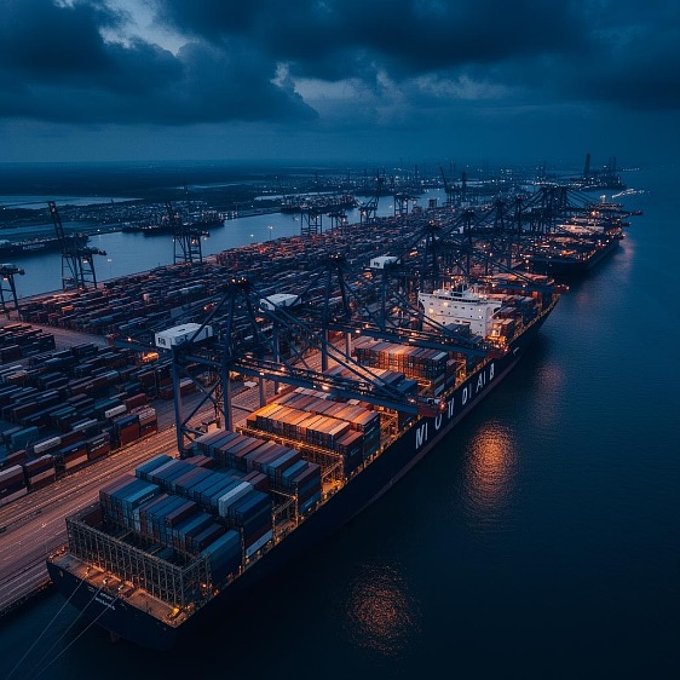
None of this makes fences, cameras and access control obsolete. They remain the foundation of every port’s security. But their role is changing: they are no longer the first line of defence, but the last.
In front of them, layers are needed that take effect earlier – in the approach areas at sea and on land, in the access corridors, at the entry points. The earlier an anomaly is detected, the more time remains to assess it and respond appropriately.
Regulatory pressure is growing as well. Under Germany’s KRITIS umbrella act, in force since March 2026 and implementing the EU Critical Entities Resilience (CER) Directive, operators of critical facilities must carry out risk assessments and implement resilience measures – explicitly for physical security, not just for IT.
Many ports already have radar, cameras, AIS reception and vessel traffic services. And yet gaps remain. Why that is – and why they usually lie not within individual systems but between them – is the subject of the next article in this series.
The fence stays – but it is the last line, not the first
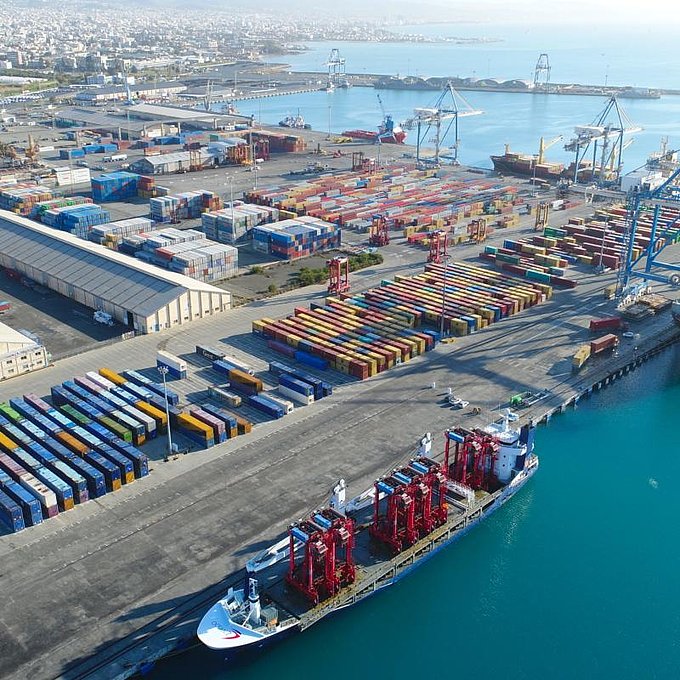
None of this makes fences, cameras and access control obsolete. They remain the foundation of every port’s security. But their role is changing: they are no longer the first line of defence, but the last. In front of them, layers are needed that take effect earlier – in the approach areas at sea and on land, in the access corridors, at the entry points. The earlier an anomaly is detected, the more time remains to assess it and respond appropriately.
Regulatory pressure is growing as well. Under Germany’s KRITIS umbrella act, in force since March 2026 and implementing the EU Critical Entities Resilience (CER) Directive, operators of critical facilities must carry out risk assessments and implement resilience measures – explicitly for physical security, not just for IT.
Many ports already have radar, cameras, AIS reception and vessel traffic services. And yet gaps remain. Why that is – and why they usually lie not within individual systems but between them – is the subject of the next article in this series.
White paper: Maritime Resilience
“Germany’s ports are not unprotected. But for the hybrid threat landscape of the coming years, they are not sufficiently resilient.” This is the central finding of the joint white paper by PLATH and Eraneos. It shows what is at stake in a crisis and how existing systems can be connected into a shared situational picture.
Request the white paper
Part 2 of the series: “The Security Gap Is Between the Systems”
Follow us on LinkedIn to be the first to know: www.linkedin.com/company/plath-systems-integration/
