
Port security: from individual systems to a shared situational picture.
Maritime resilience
Ports are key hubs for foreign trade, energy supply and industrial supply chains – and, in the event of a crisis or alliance deployment, also for military logistics, host nation support and deployability.
At the same time, the threat landscape is changing. It encompasses drones, sabotage, cyber-attacks on IT and OT, GPS and AIS spoofing, electromagnetic interference, insider risks and ship movements that are difficult to identify. These threats impact highly complex infrastructures, existing security systems and a variety of responsibilities.
Effective port security therefore requires more than individual sensors or additional stand-alone solutions.
PLATH and Eraneos pursue an integrated approach: intelligently networking existing security, operational and situational data, closing information gaps and consolidating relevant information into a shared situational picture.
This creates the basis for detecting threats earlier, assessing risks more quickly and responding appropriately.
New white paper (published 2 Sep)
PLATH and Eraneos set out in more detail what this approach might look like in their new white paper:
‘Maritime Resilience – Protecting Critical Infrastructure in the Maritime Domain’
The white paper will be published on 2 September 2026 and, amongst other things, outlines a structured approach ranging from threat and risk analysis, through the identification of existing gaps and the development of a target vision, to proof of concept, implementation, financing and a roadmap.
From 2 September, the white paper will be available on request.
Request your copy now!
The security vulnerability arises between the systems.
Germany’s ports are not unprotected. Existing strategies and systems make an important contribution to security in day-to-day operations.
However, traditional physical security alone is no longer sufficient to deal with coordinated hybrid threats.
The challenge increasingly lies in integration: cameras, sensors, port IT, control centres, operational processes and official reporting channels must consolidate information in such a way that isolated data sets form a robust overall picture.
PLATH and Eraneos identify three key drivers of today’s security gap:
INCREASED THREAT
Hybrid threats can combine physical, electronic and human attack vectors – ranging from drones and sabotage to cyber-attacks and spoofing, right through to insider risks.
SEGMENTED SECURITY APPROACHES
Many existing systems perform their respective tasks reliably. However, if information is viewed in isolation, connections and anomalies may go undetected.
GOVERNANCE GAPS
Technology alone cannot resolve a security situation. Responsibilities, funding, processes and cooperation between operators, authorities and security organisations must also be defined and safeguarded.
Closing the gap
Make the most of what we have. Fill the gaps. Boost resilience.
Modern port security does not begin with the complete replacement of existing security technology.
It begins with its intelligent networking.
Ports already have cameras, access control systems, control centres, radar, maritime systems, IT and OT infrastructures, as well as other sensors and data sources.
The integrated approach builds on these existing investments and incorporates them where additional capabilities are required.
The aim: not to create new parallel structures, but to establish a modular port security system that combines existing and new capabilities to provide a unified situational picture.
The shared situational picture
Four levels of integrated port security
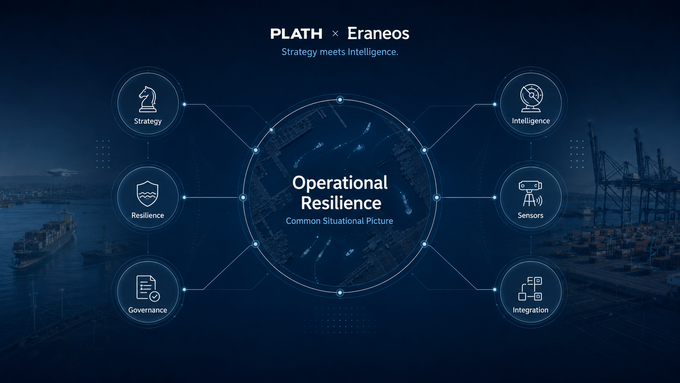
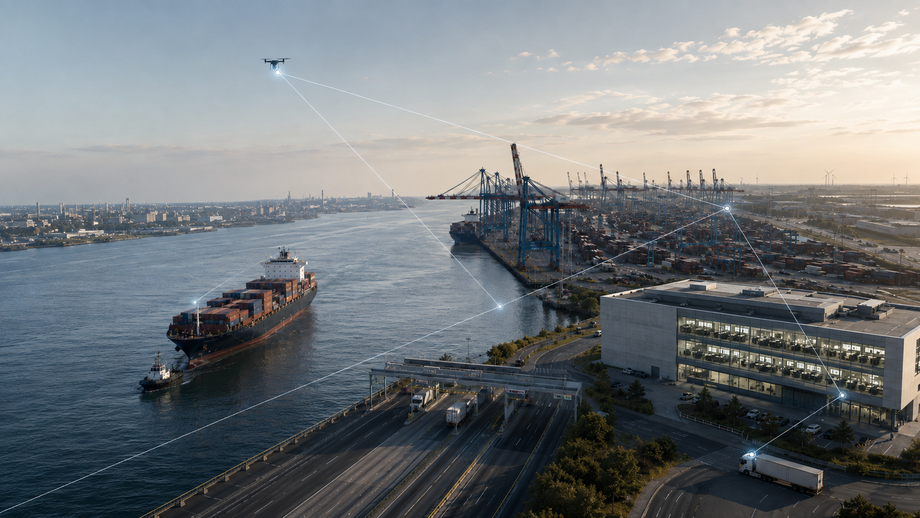
A shared situational picture is not created by a single sensor. It is created through the structured interaction of different capabilities.
01 SENSING
Suitable sensors and data sources provide the necessary situational awareness.
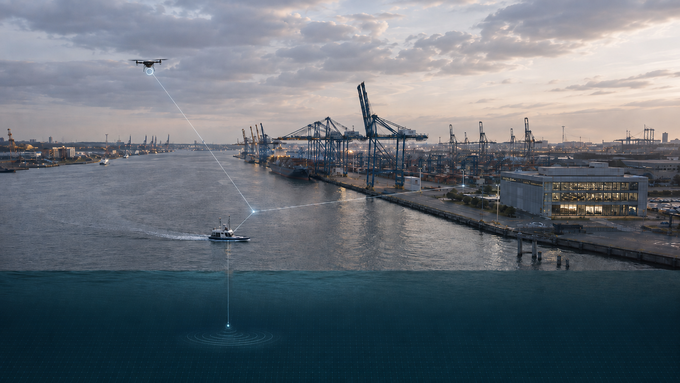
Depending on the location and threat situation, data from, for example, radar, satellites, cameras, drones, AIS, thermal imaging, underwater and sonar systems, as well as information from existing security systems, can be incorporated.
02 DATA FUSION & VERIFICATION
Information from different sources is consolidated, cross-referenced and checked for plausibility. This makes it possible to identify discrepancies and anomalies that might not be detectable within a single system.
03 ANALYSIS & SITUATIONAL AWARENESS
Verified information is consolidated into a shared, real-time situational picture. Incidents can be assessed, risks categorised and relevant information prioritised.
04 DECISION-MAKING & RESPONSE
The shared situational picture helps the responsible bodies to make decisions more quickly and on the basis of a broader range of information. The aim is a coordinated response across organisational boundaries and, where necessary, across different authorities.
From individual systems to one common picture.
Not more data. Better information.
More sensors do not automatically mean greater security. The key added value arises when information from different sources is correlated, evaluated and placed within a shared context.
In this way, a single detection becomes a situation that can be assessed; multiple data points may reveal a pattern. Individual systems can thus be combined to form a shared situational picture.
Where an integrated situational overview can make all the difference
Application scenarios
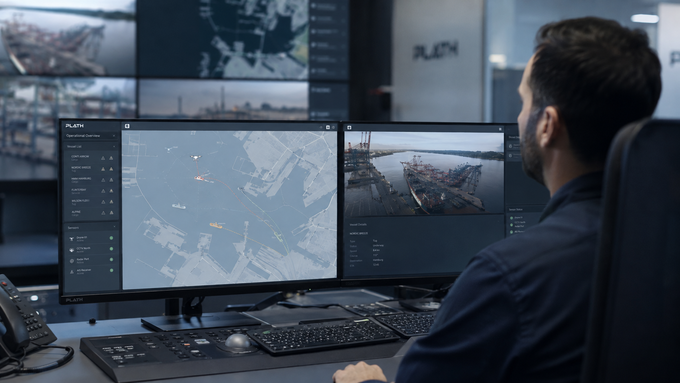
SPOOFING & SHADOW FLEETS
Radar, satellite and AIS data can be analysed together to better detect manipulated positions, unusual changes of course or other suspicious anomalies. Particularly in the case of so-called ‘dark vessels’, combining different sources can provide additional clues.
SABOTAGE & TERRORISM
Sensitive port areas, energy infrastructure, locks or submarine cables require early warning and rapid situation assessment. An integrated situational picture can consolidate relevant information and support operational coordination.
SMUGGLING & ILLEGAL TRANSPORT
Information on container logistics, supply vessels and vessels with unclear identities can be analysed together to prioritise unusual patterns and suspicious movements more quickly.
CRUISE SHIPS & PASSENGER TERMINALS
Where there are high volumes of people, a shared situational picture supports early detection, visitor management, and risk and evacuation management.
These four application scenarios also serve as key examples of the added value of integrated situational pictures in the joint PLATH-Eraneos white paper.
Resilience is more than just technology.
[Translate to English:] Ein gemeinsames Lagebild entfaltet seinen Wert erst dann vollständig, wenn klar ist, wer auf welche Information wie reagieren kann.
Sensors detect. Systems analyse. But only clear processes and lines of responsibility enable an effective response.
The technical building blocks of an integrated port security system are, in principle, available. One of the key challenges therefore lies at the institutional level: in terms of responsibilities, funding, the legal framework and cooperation between different stakeholders.
A resilient port security concept must therefore bring together several levels:
TECHNOLOGY
Sensors, data integration, analysis and situational awareness
PROCESSES
Clear procedures for assessment, escalation and response
GOVERNANCE
Defined roles and responsibilities
COORDINATION
Cooperation between port operators, authorities and operational security forces
RESILIENCE
Maintaining critical functions even in the event of disruption
A shared situational picture only realises its full value once it is clear who can react to which information and how.
No two harbours are the same.
MODULAR. INTEROPERABLE. SCALABLE.
Size, geographical location, cargo flows, adjacent industry, energy infrastructure, existing systems and specific threat profiles vary from location to location. For this reason, there is no one-size-fits-all port security configuration.
An integrated approach must build on the existing infrastructure and be tailored to the actual risks and requirements of the port in question.
MODULAR
Additional capabilities can be integrated where existing systems have security or information gaps.
INTEROPERABLE
Different sensors, systems and data sources are not considered in isolation, but are interconnected via suitable interfaces.
SCALABLE
The architecture can be scaled up from individual security zones to complex, distributed port infrastructures.
MANUFACTURER-NEUTRAL
The site’s requirements determine the appropriate technologies – not the other way round.
The joint approach by PLATH and Eraneos explicitly relies on existing infrastructure, rather than establishing cost-intensive parallel structures.
Strategy meets intelligence.
PLATH × ERANEOS
Maritime resilience arises where technological, operational and strategic perspectives converge. PLATH and Eraneos support port operators, national governments and security authorities in assessing existing capabilities, identifying security gaps and developing an integrated vision.
In particular, PLATH contributes its expertise in intelligence, networked system architectures and the integration of diverse data and sensor sources. Eraneos complements this joint approach with strategic, organisational and governance perspectives on resilience and transformation.
Together, this results in a vendor-neutral approach that spans the entire spectrum from threat analysis through to proof of concept and implementation.
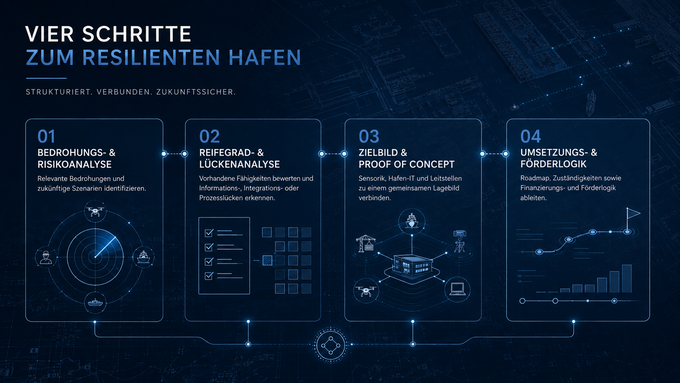
Four steps towards a resilient port
01 THREAT & RISK ANALYSIS
What threats are relevant to your site today – and what scenarios might arise in the future?
The starting point is a consolidated and robust maritime threat and risk assessment.
02 MATURITY & GAP ANALYSIS
What protective capabilities and systems are already in place?
Where are there gaps in information, integration or processes? On this basis, effective and economically viable measures can be prioritised on a risk-based approach.
03 TARGET VISION & PROOF OF CONCEPT
How can existing sensor technology, port IT, control centres and reporting channels be integrated to form a unified situational picture?
A proof of concept enables a scalable target vision to be tested under realistic conditions – whilst deliberately incorporating existing infrastructure.
04 IMPLEMENTATION & FUNDING LOGIC
How can the target vision be turned into a robust solution?
This involves a realistic roadmap, clear responsibilities and the consideration of suitable financing and funding opportunities.
The next step: your location.

Where are the gaps in your port security today?
What systems are already in place?
Which threats are particularly relevant to your site?
What information is missing to provide a robust situational picture?
And how can existing and new capabilities be effectively combined?
Talk to PLATH and Eraneos about a proof of concept for your site.
Learn more about maritime resilience
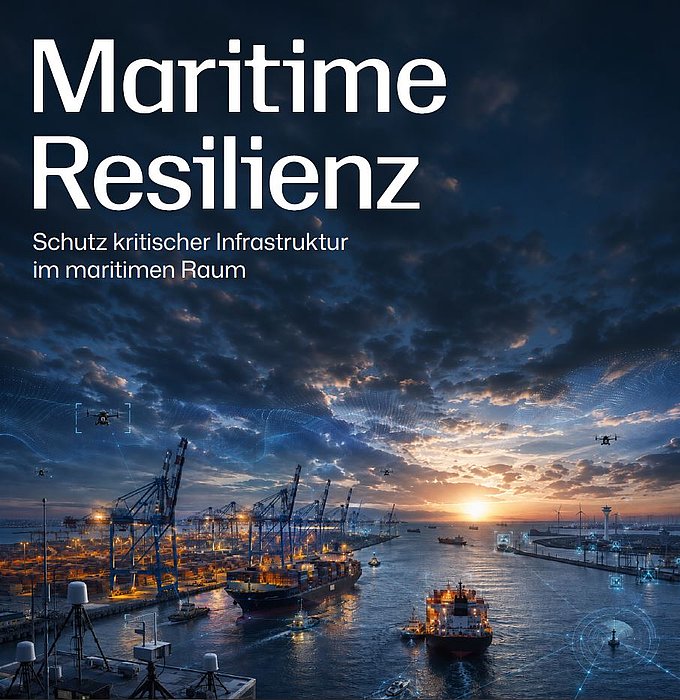
How resilient are Germany’s ports to the hybrid threat landscape of the coming years?
In their joint white paper, ‘Maritime Resilience – Protecting Critical Infrastructure in the Maritime Domain’, PLATH and Eraneos analyse the current security situation, highlight structural gaps and outline an integrated approach to future port security.
REQUEST THE WHITE PAPER (available from 2 September)
